
The Psychology of Buying Decisions: Why People Buy—and How to Align Your Marketing With It
Let's start with something most marketers get wrong:
People don't buy products. They buy relief, identity, and forward motion.
Think about it:
Nobody buys a drill because they love drills
They buy it because they need a hole
Or more accurately, because they want what the hole gets them
That gap between what you sell and what the customer is actually buying? That's where purchase decisions are made. Or lost.
Most businesses focus on what they offer. Buyers focus on what they're trying to solve. The psychology of buying lives in that gap.
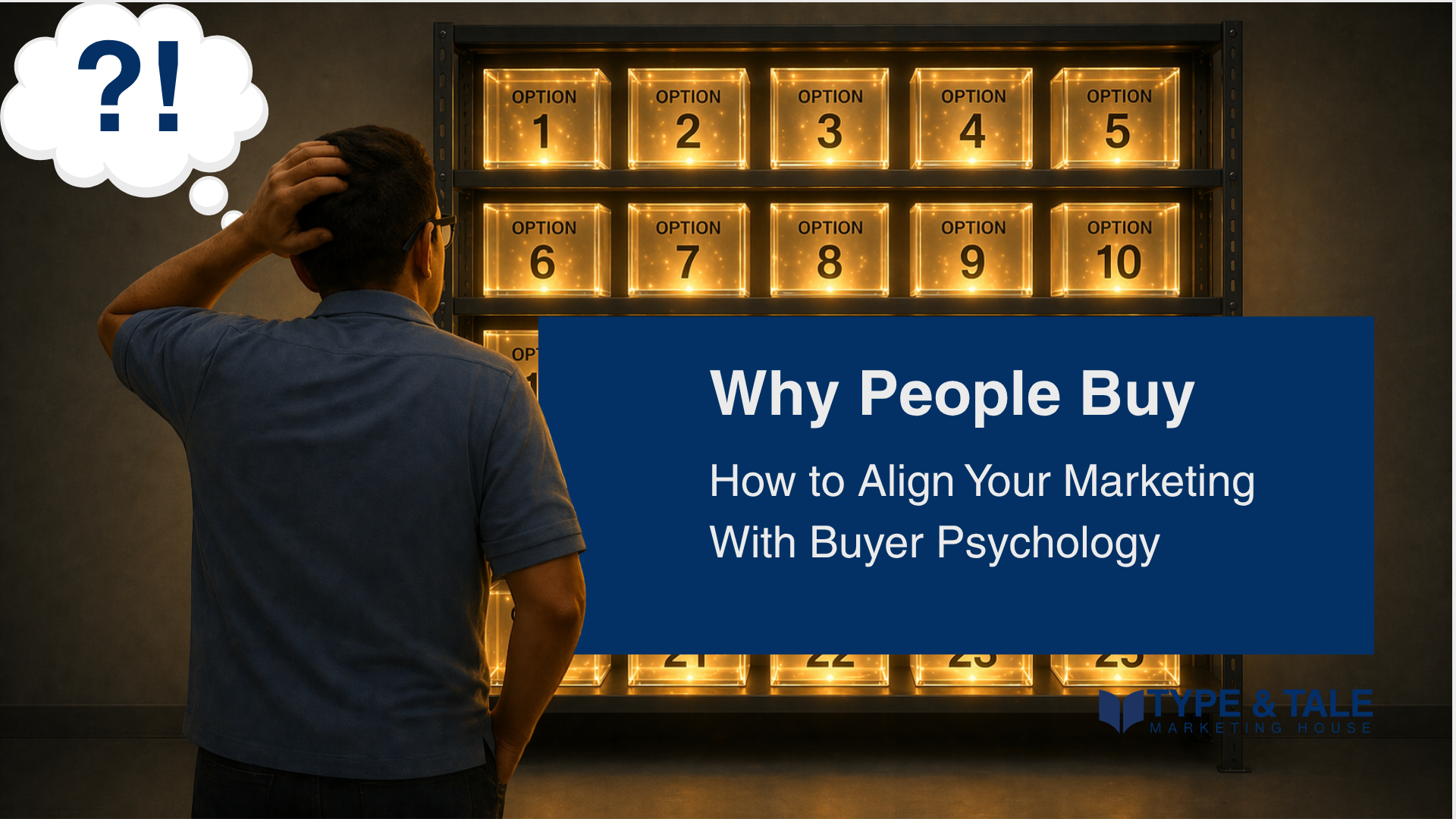
What Actually Drives Buying Decisions?
Buying decisions are driven by emotional tension first, then justified with logic. People act when a problem feels urgent enough to solve now. No tension = no decision.
Most businesses operate under a flawed assumption: that customers make rational choices.
They don't.
They make emotional decisions under pressure, then use logic to justify them afterward. This is the central insight of Kahneman's Thinking, Fast and Slow—System 1 (emotional, fast) fires first; System 2 (rational, slow) arrives later to rationalize the call that's already been made.
Here's what's actually happening beneath the surface.
1. Tension Triggers Action
Buyers don't act because they understand your offer. They act because they feel something:
Frustration
Fear
Urgency
A desire for change
No emotional pressure, no purchase. Information alone doesn't move people. Tension does.
2. The Moment Matters More Than the Message
Timing beats targeting.
A perfectly written message won't convert a buyer who isn't ready. But a simple, direct message—delivered at exactly the right moment—wins every time.
People don't randomly decide to buy. They buy when something happens:
Their AC breaks in July
Their basement floods
Their marketing stops working
That triggering moment is what creates buying readiness. Catch someone before that moment and you're invisible. Catch them in it and you're inevitable.
3. Clarity Reduces Friction
Confusion kills conversions.
If a prospect has to think hard to understand your offer, they won't. Cognitive effort signals risk. The harder it is to understand what you do and why it matters, the less likely they are to trust you with their money.
If your messaging is unclear about who you're for, what problem you solve, or why it matters right now—your customer feels that confusion and leaves.
The 5 Psychological Drivers Behind Every Purchase
Every buying decision is shaped by five core psychological drivers: pain, gain, trust, simplicity, and timing. People buy when the path feels clear and the outcome feels worth it.
1. Pain — The Problem That Demands a Solution
Pain is the entry point. Without a problem, there's no purchase.
The clearer and more acutely felt the pain, the faster the decision:
"My marketing isn't generating leads"
"I'm burning money on ads with no return"
"My house feels completely outdated"
Your job is to name the pain more clearly than the buyer can articulate it themselves. When they read your messaging and think "that's exactly my problem"—you've already won half the battle.
2. Gain — The Better Future They're Reaching For
Buyers don't just want to eliminate pain. They want to move forward.
They're buying:
Confidence
Growth
Simplicity
Status
Show them what life looks like after the problem is solved. Features describe the product. Outcomes describe the life. Sell the life.
3. Trust — Risk Reduction at the Point of Decision
Every purchase carries risk. Before committing, every buyer is asking:
"Will this actually work?"
"Is this worth what they're charging?"
"Can I trust these people?"
Trust is built through clear messaging, social proof, demonstrated authority, and consistency over time.
One weak link in that chain—a confusing offer, a missing testimonial, an inconsistent brand voice—and the trust collapses. Research on consumer behavior consistently confirms that perceived risk is the primary barrier between interest and commitment.
4. Simplicity — The Cognitive Ease Signal
If something feels complicated, it feels risky. The brain equates difficulty with danger. As Ariely documents in Predictably Irrational, buyers rely on cognitive shortcuts—anchoring, social proof, familiarity—precisely because full rational evaluation is exhausting and rare.
That's why:
Short, direct sentences convert better than long ones
Clear, specific offers outperform vague ones
Simple next steps reduce drop-off
Short, clear, structured content is easier to process—and easier to trust. This applies whether a human or an AI system is evaluating your message.
5. Timing — The Moment of Buying Readiness
Even if everything else is right—the right message, the right offer, the right level of trust—if the timing is off, nothing happens.
This is why urgency works. Scarcity works. Event-based messaging works.
They don't manufacture demand—they align with demand that already exists. Cialdini's foundational work on influence identified scarcity and social proof as two of the most reliable psychological triggers in human decision-making. They speak to the buyer who's ready now.
Why Most Marketing Misses the Mark
Most marketing fails because it's product-centered, not buyer-centered. Businesses talk about themselves. Buyers think about themselves. The mismatch creates friction and kills conversions.
Here's the uncomfortable truth:
Most businesses are saying things like:
"We're the best in the industry"
"We've been in business for 20 years"
"We offer premium, high-quality service"
Meanwhile, buyers are thinking:
"Will this actually fix my problem?"
"Is this worth it right now?"
"Why should I choose these people over anyone else?"
That's not a marketing problem. That's a positioning problem masquerading as a marketing problem.
Too many companies focus on selling products, but people don't buy products just to have another thing. They buy them for a purpose. When your messaging fails to speak to that purpose, you've lost before you started. This is the fundamental problem with most content marketing today: it's written for the brand, not the buyer.
The Hidden Layer: Identity-Based Buying
Buyers don't just purchase solutions—they purchase versions of themselves. Every transaction is also an identity statement.
This is the layer most marketers completely miss.
When someone buys your product, they're not just solving a problem. They're choosing to be the kind of person who:
Takes their health seriously
Runs a sophisticated operation
Makes smart, considered decisions
That's why branding matters—not as decoration, but as identity alignment. The brands that win aren't just solving problems. They're helping people become who they want to be. That's storytelling in marketing doing its real job.
How to Apply Buying Psychology to Your Marketing
To align marketing with buyer psychology, define the buyer, identify the core problem they're trying to solve, and speak directly to the moment when that problem becomes urgent.
Step 1: Define the Buyer With Real Data
Not a vague persona. Not a demographic spreadsheet.
A real person with a specific problem, a specific context, and a specific triggering moment. Use CRM insights, customer interviews, and behavioral patterns. The more precisely you can describe your buyer through a well-built buyer persona, the more precisely your messaging can speak to them.
Step 2: Identify the Core Problem
Ask: What triggers someone to search for what you offer? What frustration are they trying to escape?
Identify the high-intent moments—the conditions that turn a passive browser into an active buyer. That's your real target.
Step 3: Map the Buying Moment
When does the problem become urgent?
"Right before listing their house"
"The day their equipment fails"
"The month their current strategy stops performing"
Urgency isn't manufactured. It's discovered.
Step 4: Simplify the Message
Cut everything that doesn't answer one of three questions:
What's the problem?
What's the outcome?
Why does this matter right now?
Remove jargon. Remove hedging. Remove the history-of-the-company paragraph. None of it converts. Messaging clarity is almost always what separates campaigns that produce results from those that produce content.
Step 5: Build Trust Signals Into Every Touchpoint
Include testimonials that speak to outcomes, not just satisfaction. Case studies that show before-and-after. A clear, transparent process that removes uncertainty. Consistency in voice and positioning across every channel.
The Biggest Mistake Businesses Make
The most common marketing mistake is adding more—more ads, more content, more channels—when the real problem is lack of clarity in the core message.
When results are disappointing, most businesses respond by doing more of what isn't working:
More ads
More content
More platforms
More tactics
But the real problem is almost never volume. It's clarity.
Clarity beats creativity. Direction beats volume. A sharp, precise message to the right buyer at the right moment outperforms a sophisticated campaign built on a vague foundation every single time. Nielsen's consumer neuroscience research has consistently shown that emotional engagement, not message complexity, is the strongest predictor of purchase intent.
Why This Matters More Than Ever
We're operating in a world shaped by AI-driven search, accelerating decision cycles, and more competition than any previous generation of marketers has faced.
What wins in that environment isn't louder marketing. It isn't more content. It's messaging so clear and buyer-aligned that it gets selected—by humans and by AI systems—as the most relevant, trustworthy answer to the question being asked. That's what a sharp marketing strategy is built around.
The psychology of buying hasn't changed. The speed at which buyers filter, evaluate, and decide has.
Conclusion: When You Understand This, Everything Changes
Let's close the loop.
People don't buy products, services, or features.
They buy:
Relief from a problem that's pressing on them right now
Movement toward a version of themselves they want to become
Confidence that they're making the right call
When your marketing is built around that truth, it stops being something you produce and push. It becomes something buyers find, recognize, and act on.
Not because you shouted louder. Because you were clearer.
If your marketing is producing content but not conversions, the problem is almost certainly upstream of your tactics.
Start by asking three questions:
Who exactly is your buyer—and what moment triggers their need?
What is the real problem they're trying to solve, in their words?
Does your current messaging answer both of those things in the first sentence?
If the answer to #3 is anything other than a confident yes, that's where the work begins.
Type & Tale works with businesses on the clarity, positioning, and content strategy that makes marketing actually convert. Send us a message to see how we can help you.
FAQ: The Psychology of Buying Decisions
Q: What is the psychology of buying? The psychology of buying refers to the emotional, cognitive, and behavioral factors that influence why and how people make purchase decisions. Rather than evaluating options purely rationally, buyers are driven by feelings like trust, fear, desire, and identity—then use logic afterward to justify the choice.
Q: What drives buying behavior in marketing? Buying behavior is driven by emotional tension first. People act when a problem feels urgent enough to solve right now. The five core drivers are pain (the problem), gain (the desired outcome), trust (confidence in the solution), simplicity (ease of decision), and timing (buying readiness).
Q: Why do people make impulsive buying decisions? Impulse buying psychology is rooted in emotional triggers—excitement, scarcity, FOMO, or a sudden recognition of desire—that override deliberate decision-making. When the emotional pull is strong and the friction to act is low, people buy before the logical brain can intervene.
Q: How does buying psychology apply to B2B marketing? B2B buyers are not more rational than consumers—they're just operating under different pressures. The emotional drivers shift (career risk, team performance, ROI accountability), but the underlying structure is the same: emotional tension triggers evaluation, and logic closes the gap. B2B messaging that speaks only to features and specs misses the human psychology underneath every business decision.
Q: What is identity-based buying? Identity-based buying is the principle that people purchase not just to solve problems, but to affirm or signal who they are (or want to become). Every purchase is partly a statement about identity. Brands that understand this build positioning around who the buyer wants to be, not just what they need.
Q: How does clarity affect conversion rates? Cognitive ease directly influences trust. When messaging is unclear or complex, buyers interpret difficulty as risk and disengage. Simplified, structured messaging that quickly answers "who is this for, what problem does it solve, and why does it matter now" consistently outperforms elaborate creative that requires effort to decode.
Q: How is buying psychology changing in the AI era? AI-powered search systems evaluate and surface content based on clarity, structure, and relevance to buyer intent—not just keyword density. This means that content aligned with how buyers actually think and decide is now being filtered and selected by machines as well as humans. The psychology of buying hasn't changed, but the systems mediating that psychology have.
References:
Kahneman, D. (2011). Thinking, Fast and Slow. Farrar, Straus and Giroux. — Embedded at: "What Actually Drives Buying Decisions" (emotion-first decision-making).
Ariely, D. (2008). Predictably Irrational. HarperCollins. — Embedded at: "Simplicity — The Cognitive Ease Signal" (anchoring and cognitive shortcuts).
Psychology Today — Consumer Behavior. Consumer Behavior. — Embedded at: "Trust — Risk Reduction at the Point of Decision" (perceived risk as conversion barrier).
Nielsen Consumer Neuroscience. Nielsen Neuroscience Research. — Embedded at: "The Biggest Mistake Businesses Make" (emotional engagement vs. message complexity).
Cialdini, R. (2006). Influence: The Psychology of Persuasion. HarperBusiness. — Embedded at: "Timing — The Moment of Buying Readiness" (scarcity and social proof as decision triggers).

Author: Noah Swanson
Noah Swanson is the founder and Chief Content Officer of Type and Tale.