
The Effective Stories System
A Better Way to Make Your Marketing Clear, Compelling, and Customer-Focused
Most marketing has plenty of information.
But little of it has a story. And that’s the problem.
Businesses explain what they do. They highlight features, benefits, values, and all the things they believe should make someone care.
But the customer is asking a different question. They want to know the answers to questions like:
“Is this for me?”
“Do they understand my problem?”
“Can they help me fix it?”
“What do I do next?”
When your marketing does not answer those questions clearly, people do not lean in. They move on.
Not because your business is bad.
Not because your product is weak.
Not because you need to post more.
But because the message has no path.
That is what the Effective Stories System is designed to fix.
The Effective Stories System is a marketing storytelling framework that helps businesses organize their message around the customer’s journey from problem to action.
It gives your marketing a structure people can follow.
Because confused people do not buy.
And clear stories move people forward.
What Is the Effective Stories System?
The Effective Stories System is a customer-focused marketing framework that helps businesses clarify who they serve, what problem they solve, when that problem becomes urgent, and how their offer helps the customer move toward a better outcome.
In short: The Effective Stories System turns scattered marketing into a clear customer journey.
Most marketing starts in the wrong place.
It starts with the business.
“We’ve been around since 2003.”
“We offer full-service solutions.”
“We care about quality.”
“We provide exceptional customer service.”
None of those statements are necessarily wrong. They’re just not where your customer’s story begins.
Your customer’s story begins with a problem.
More specifically, it begins in a moment when that problem becomes hard to ignore.
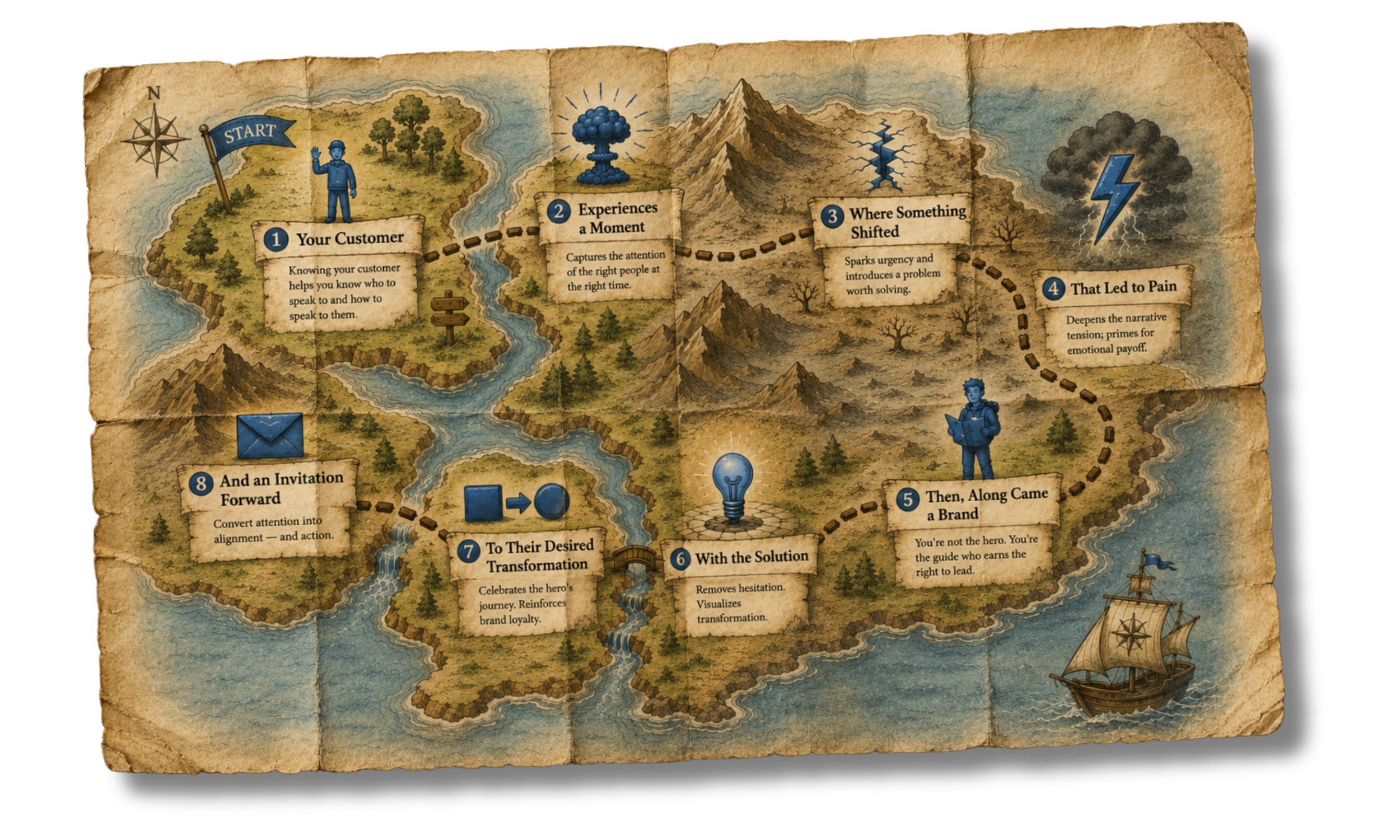
That is why the Effective Stories System follows a simple story arc:
Your Customer
Experiences a Moment
Where Something Shifted
That Led to Pain
Then, Along Came a Brand
With the Solution
To Their Desired Transformation
And an Invitation Forward
This structure matters because story gives your marketing sequence.
It helps people understand:
Who this is for
What changed
Why it matters
What hurts
Who can help
What the solution is
What life looks like after
What to do next
That is the difference between marketing that explains and marketing that moves.
Why Story Structure Matters in Marketing
Story structure matters because people make sense of problems through sequence.
They do not process your business as a random pile of facts. They are trying to understand how your business fits into the situation they are already living.
That is why storytelling works in marketing. It helps the customer see themselves, feel the problem, understand the stakes, trust the guide, and move toward action.
Story is not decoration. Story is decision architecture.
This does not mean every piece of marketing needs to begin with “once upon a time.”
That is not the point.
Story-driven marketing is not about turning your brand into a fairy tale. It is about using the elements of story to make your message clear.
A good story answers the questions your customer is already asking:
What is happening?
Why does this matter?
Who understands this?
What happens if I do nothing?
What path should I take?
Research from Princeton has shown that when people listen to a story, the listener’s brain activity can mirror the speaker’s brain activity. This is often referred to as neural coupling. In plain English: stories help people connect, process, and remember ideas more deeply. You can read more about that research from Princeton University.
That is one reason marketing built around story often feels more human.
It gives people something to follow.
And when people can follow the message, they are more likely to trust the next step.
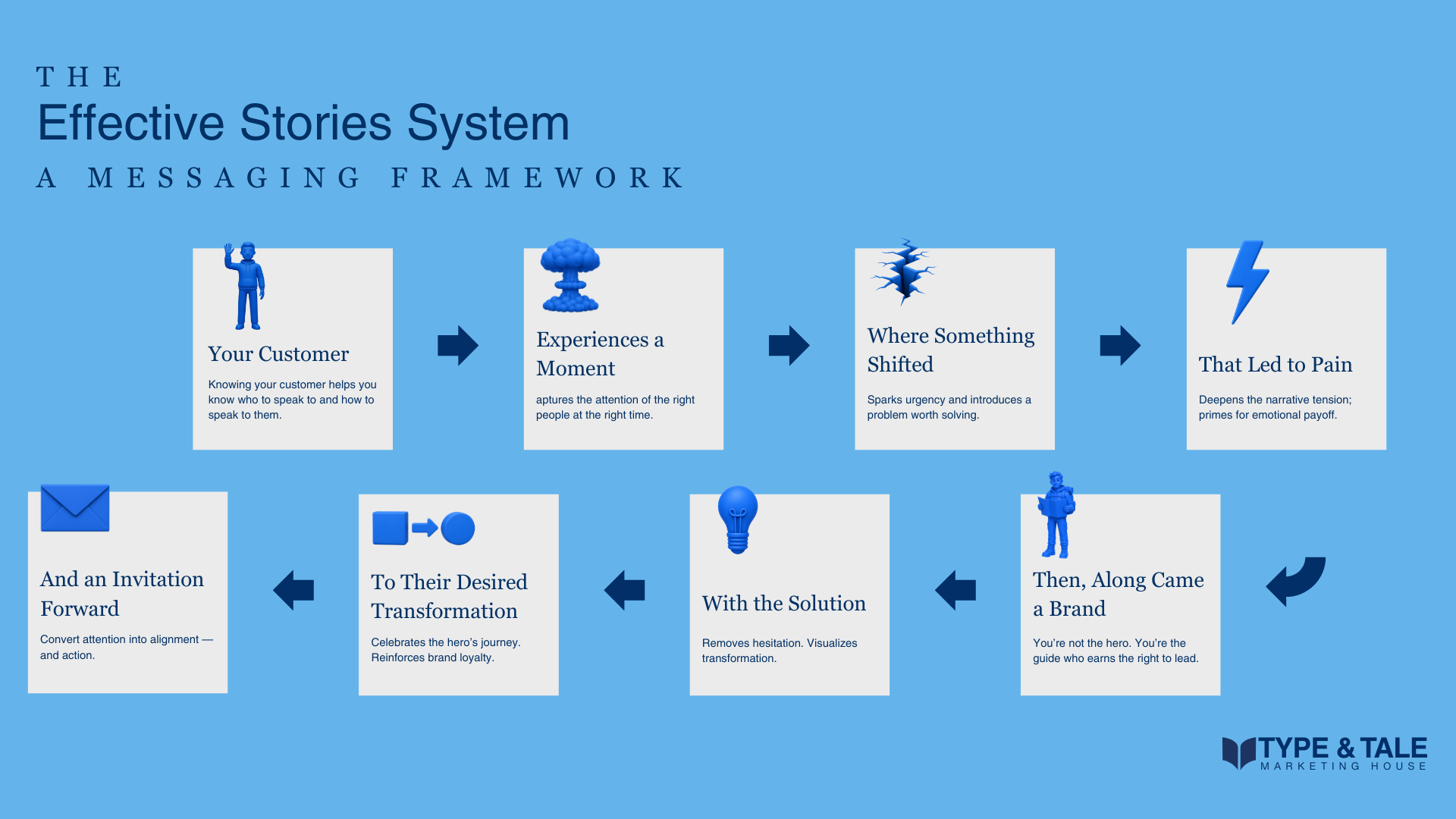
The 8 Elements of the Effective Stories System
The Effective Stories System has eight core elements.
Each one helps answer a different question in the customer’s mind.

1. Your Customer
Who is this for?
Before you write better copy, run better ads, or build better content, you need to know who you are talking to.
Not a vague demographic.
Not “homeowners.”
Not “small businesses.”
Not “women ages 35–55.”
You need to know the person behind the purchase.
What are they trying to solve?
What are they tired of dealing with?
What have they already tried?
What are they afraid will happen if they choose wrong?
What would make them finally say, “That’s exactly what I need”?
This is why customer clarity is the first piece of the system. If you are fuzzy on the customer, your message will always feel a little off.
Type & Tale has covered this deeper in our post on why knowing your customer is a competitive advantage. The simple idea is this: businesses often think they know their customer because they know demographic details. But real customer understanding goes deeper than age, income, job title, or location.
You need to understand the customer’s lived reality.
Because the goal of marketing is not to impress people.
It is to make them feel recognized.

2. Experiences a Moment
When does your customer start paying attention?
This is the piece most marketing skips.
Businesses spend a lot of time defining their ideal customer. That is useful. But it is incomplete
A customer profile tells you who the person is.
A buyer moment tells you when they care.
That difference matters.
Your customer may technically fit your audience. They may have the right income, job title, location, and need. But if nothing has happened to make the problem urgent, your message is just noise.
A buyer moment is the point where attention opens.
It could be:
A business owner realizes referrals have slowed down.
A marketing director is asked to prove ROI.
A homeowner notices water damage.
A founder sees a competitor gaining traction.
A parent realizes the current solution is no longer working.
The moment creates relevance.
Without it, even good messaging can feel invisible.
This connects closely to why many ads fail. The problem is not always the creative, offer, or platform. Sometimes the message simply missed the customer’s moment. That is why we recommend reading Why Your Ads Didn’t Work and What to Fix First alongside this framework.
More exposure will not fix the wrong moment.
It will only increase the rate of irrelevance.

3. Where Something Shifted
What changed?
Every real story begins when the old normal gets interrupted.
Something shifts.
The customer was living one way. Then something happened that made the old way feel less stable, less safe, less useful, or less acceptable.
This is the inciting incident.
In marketing, this might be small. It does not have to be dramatic.
Maybe a business owner sees three straight months of flat lead flow.
Maybe a homeowner finally gets embarrassed by the outdated kitchen when hosting friends.
Maybe a sales manager realizes the team keeps answering the same objection on every call.
Maybe a company launches a new service and nobody understands it.
The shift matters because people usually do not act when everything feels fine.
They act when the current story cracks.
In short: Customers do not move because your product exists. They move because something changed.
This is where many brands get the order wrong.
They lead with the solution before naming the shift.
But if the customer does not recognize the shift, they will not feel the need for your solution.

4. That Led to Pain
What does the problem feel like?
Most businesses describe problems at the surface level.
“Our customers need more leads.”
“Our customers need a new website.”
“Our customers need better flooring.”
“Our customers need a more efficient process.”
Again, not wrong.
But surface-level problems rarely create strong connection.
The deeper question is: What does the problem feel like to live with?
A business owner does not just need more leads. He is tired of wondering if next month will be slow.
A marketing director does not just need clearer messaging. She is tired of defending campaigns that are hard to explain.
A homeowner does not just need a remodel. She is tired of feeling embarrassed by a space that no longer fits her life.
Pain creates tension.
And tension creates attention.
This is why customers buy relief before they buy products.
They do not wake up wanting your service.
They wake up wanting the pain to stop.
That pain might be practical.
It might be emotional.
It might be financial.
It might be tied to identity.
But if your message does not name the pain clearly, your customer may not trust you with the solution.
As Type & Tale has written before, clarity in marketing means a buyer can quickly understand what you offer, who it is for, and what to do next. But clarity also means they can recognize the problem you solve.
If your customer cannot see their pain in your message, they will not see your offer as relevant.

5. Then, Along Came a Brand
What role does your brand play?
This is where the brand enters the story.
But here is the part businesses often get wrong:
Your brand is not the hero.
Your customer is.
Your brand is the guide.
That means your job is not to make yourself look impressive. Your job is to help the customer move forward with confidence.
This is one reason many “brand stories” fall flat. They are really company biographies.
They talk about when the business started, why the founder cared, how many years of experience they have, and what values they hold.
That can matter.
But only if it helps the customer trust you as the guide.
A strong brand story should make the customer think:
“They understand me.”
“They know what they’re doing.”
“They have helped people like me.”
“This feels like the right path.”
We cover this more directly in How to Build a Brand Story That Converts, where the focus is not just telling a nice story, but building a story that creates trust and movement.
The brand’s role is to bring empathy and authority.
Empathy says, “We understand the problem.”
Authority says, “We know how to help.”
You need both.
Empathy without authority feels warm but weak.
Authority without empathy feels cold and self-important.
The guide needs both hands on the wheel.

6. With the Solution
What is the path forward?
Once the customer feels understood, the solution can enter the story.
Not before.
This is important.
Most companies introduce the solution too early.
They rush to explain the product, process, features, package, or offer before the customer feels the weight of the problem.
That creates friction.
Because when the solution shows up before the pain is clear, it feels like a pitch.
But when the solution shows up after the customer feels seen, it feels like relief.
In short: The solution only matters once the customer believes you understand the problem.
This is where your offer should feel simple.
Not shallow.
Simple.
The customer should understand what you do, how it helps, and what path they need to take.
This is especially important in the AI search era. AI systems and human buyers both need clear, structured information. If your business is hard to explain, it is harder to recommend. We explored this in How to Do Marketing in the AI Era, where the central idea is that clarity matters more than volume when systems are deciding what to surface and people are deciding what to trust.
Your solution should answer:
What do you do?
Who is it for?
What problem does it solve?
Why is your approach different?
What happens next?
If those answers are buried, vague, or scattered, your offer will feel harder to choose.

7. To Their Desired Transformation
What better future are they moving toward?
People do not just buy the solution.
They buy the after.
They buy the future state.
The feeling of finally having the problem solved.
That is transformation.
For a remodeling company, the transformation is not just a new kitchen. It is hosting without embarrassment.
For an HVAC company, the transformation is not just a fixed AC unit. It is comfort, control, and peace of mind.
For a marketing company, the transformation is not just better copy. It is knowing your message finally makes sense.
This is where marketing often gets too practical too quickly.
Yes, people need to understand the deliverables.
But deliverables are not the destination.
They are the vehicle.
The transformation is what the customer gets to experience because the problem is solved.
A strong transformation statement helps the customer picture what changes:
From scattered to clear.
From ignored to understood.
From guessing to communicating with purpose.
From random marketing to intentional growth.
From background noise to a message people recognize.
This is also where your differentiation becomes more meaningful.
You are not just saying, “Here is what makes us different.”
You are showing why that difference creates a better outcome for the customer.

8. And an Invitation Forward
What should the customer do next?
A good story needs a next step.
Marketing that builds belief but never invites action leaves the customer hanging.
That is why every effective marketing story needs a clear invitation forward.
This could be:
Book a strategy call.
Download the guide.
Get a quote.
Schedule a consultation.
Read the next article.
Reply to the email.
Start the assessment.
The point is not to be pushy.
The point is to be clear.
If the customer has followed the story this far, do not make them guess what happens next.
A vague call to action creates hesitation.
A clear call to action creates movement.
Instead of: “Learn more.”
Try: “Book a strategy call.”
Instead of: “Contact us.”
Try: “Tell us what is not working in your marketing.”
Instead of: “Get started.”
Try: “Start with a messaging clarity audit.”
The invitation should match the moment.
If the buyer is early in the journey, a helpful guide or assessment may be the right next step.
If the buyer is in pain and ready to act, a direct call or consultation may be better.
That is why the Effective Stories System does not treat calls to action as random buttons.
The CTA should be the next logical step in the customer’s story.
How to Use the Effective Stories System Across Your Marketing
The Effective Stories System is not just for your homepage.
It can shape your entire marketing system.
In short: ESS gives every channel the same core story, adapted to the customer’s moment.
Here is how that looks.
Website
Your website should quickly answer:
Who do you help?
What problem do you solve?
What moment makes that problem urgent?
What path do you provide?
What should the visitor do next?
Your homepage should not feel like a company brochure.
It should feel like a clear path.
Blog Content
Your blog should not just chase keywords.
It should answer real questions your buyer asks during real moments.
That means writing around:
Problems they are trying to understand
Mistakes they are trying to avoid
Comparisons they are considering
Costs they are trying to estimate
Timing questions they need answered
Decision points they are facing
This is where ESS supports SEO, GEO, and AEO.
The clearer your content is, the easier it is for search engines, answer engines, AI systems, and humans to understand your expertise.
Social Media
Social content should not just share tips.
It should create recognition.
A strong post can usually be built from one ESS element:
Name the customer.
Name the moment.
Name the shift.
Name the pain.
Reframe the solution.
Paint the transformation.
Invite action.
That is how you move from generic content to point-of-view content.
Email is one of the best places to use story.
A strong email can open with a moment, create tension, deliver one useful insight, and point to one clear next step.
It does not need to be long.
It needs to feel relevant.
Ads
Ads need moment clarity.
Most ads fail because they try to speak to everyone at once.
A stronger ad names the specific buyer, problem, and moment.
For example:
Weak: “Grow your business with better marketing.”
Stronger: “If your ads are getting clicks but no calls, your message may be the problem.”
The second one creates recognition.
That is the goal.
Sales Conversations
ESS can also improve sales.
Instead of jumping straight into your service list, your sales conversation should uncover:
Who the buyer is
What changed
What pain it created
What they have already tried
What outcome they want
What risk they want to avoid
What next step makes sense
That turns sales from pitching into guiding.
Why ESS Matters More in the AI Era
AI has made it easier than ever to create content.
That is good.
And dangerous.
Because if your message is unclear, AI will only help you create more unclear content faster.
The businesses that win in the AI era will not simply be the ones publishing the most. They will be the ones that are easiest to understand, trust, summarize, and recommend.
Google’s documentation on structured data explains how structured information can help search engines better understand a page. While structured data is only one part of search visibility, the larger point applies to modern marketing as a whole: clarity helps systems understand what your content is about.
The same is true for AI-driven search and recommendation.
If your business is vague, generic, or inconsistent, AI systems may struggle to explain why you are relevant.
And if AI struggles to explain your business clearly, there is a good chance customers do too.
That is why Type & Tale focuses on more than traditional SEO. We think about how your business is understood across search engines, answer engines, and AI systems.
Our post on how ChatGPT finds and recommends businesses goes deeper into this idea. AI recommendations depend on recognizable trust signals, structured business information, and consistent positioning.
ESS helps support that by making your core message easier to interpret.
Who do you help?
What problem do you solve?
When does it matter?
Why are you the right guide?
What should someone do next?
Those are not just marketing questions anymore.
They are discoverability questions.
The Biggest Mistake Businesses Make With Storytelling
The biggest mistake businesses make with storytelling is thinking the story is about them.
It usually sounds like this:
“Our founder had a dream.”
“We started in a garage.”
“We care about excellence.”
“We built this company from the ground up.”
Those things might be true. They may even be meaningful.
But they are not automatically useful to the customer.
The customer is not asking, “How can I admire this company more?”
They are asking, “Can this company help me solve my problem?”
That is why brand storytelling needs to be customer-centered.
Your story matters most when it helps the customer understand their own story more clearly.
Use your story to:
Build trust
Reveal empathy
Show authority
Reframe the customer’s problem
Give language to the pain
Show what transformation is possible
Do not use your story to ask for applause.
Use it to guide.
FAQ: The Effective Stories System
-
A marketing storytelling framework is a structure that helps businesses organize their message around the customer’s journey. Instead of listing random facts, a storytelling framework clarifies who the customer is, what problem they face, why it matters, how the brand helps, and what action the customer should take next.
-
The Effective Stories System is Type & Tale’s marketing storytelling framework. It helps businesses clarify their customer, buyer moment, pain, brand role, solution, desired transformation, and invitation forward so their marketing becomes easier to understand and act on.
-
The customer should be the hero because they are the one with the problem, decision, risk, and desired outcome. Your brand is not the main character. Your brand is the guide that helps the customer move from pain to transformation.
-
A buyer moment is the point when a customer becomes ready to pay attention. It usually happens after something shifts, such as a new problem, a failed attempt, a change in circumstances, or rising frustration. Buyer moments matter because timing often determines whether a message feels relevant or ignored.
-
Yes, storytelling can support SEO and GEO when it makes the content clearer, more structured, and easier to understand. Search engines and AI systems need clear signals about who the content is for, what question it answers, and why the source should be trusted. Story structure can help make those signals easier to identify.
-
Start by reviewing your homepage. Ask whether it clearly explains who you help, what problem you solve, what moment makes that problem urgent, what solution you offer, what transformation the customer wants, and what step they should take next. If those answers are unclear, your website likely needs stronger story structure.
Final Thoughts: Better Marketing Starts With a Better Story
Most businesses do not need more noise.
They need more clarity.
More content will not fix a message people do not understand.
More ads will not fix a story that does not connect.
More tactics will not fix a missing customer journey.
The Effective Stories System gives your marketing a path.
It helps you clarify the customer, name the moment, reveal the pain, position your brand as the guide, present the solution, show the transformation, and invite the customer forward.
Because marketing is not just about being seen.
It is about being understood.
And in a crowded market, understood is what gets chosen.
If your marketing feels scattered, start here:
Who is your customer?
What problem are they trying to solve?
What moment makes that problem matter now?
Answer those three questions clearly, and your marketing will already be ahead of most of the market.