
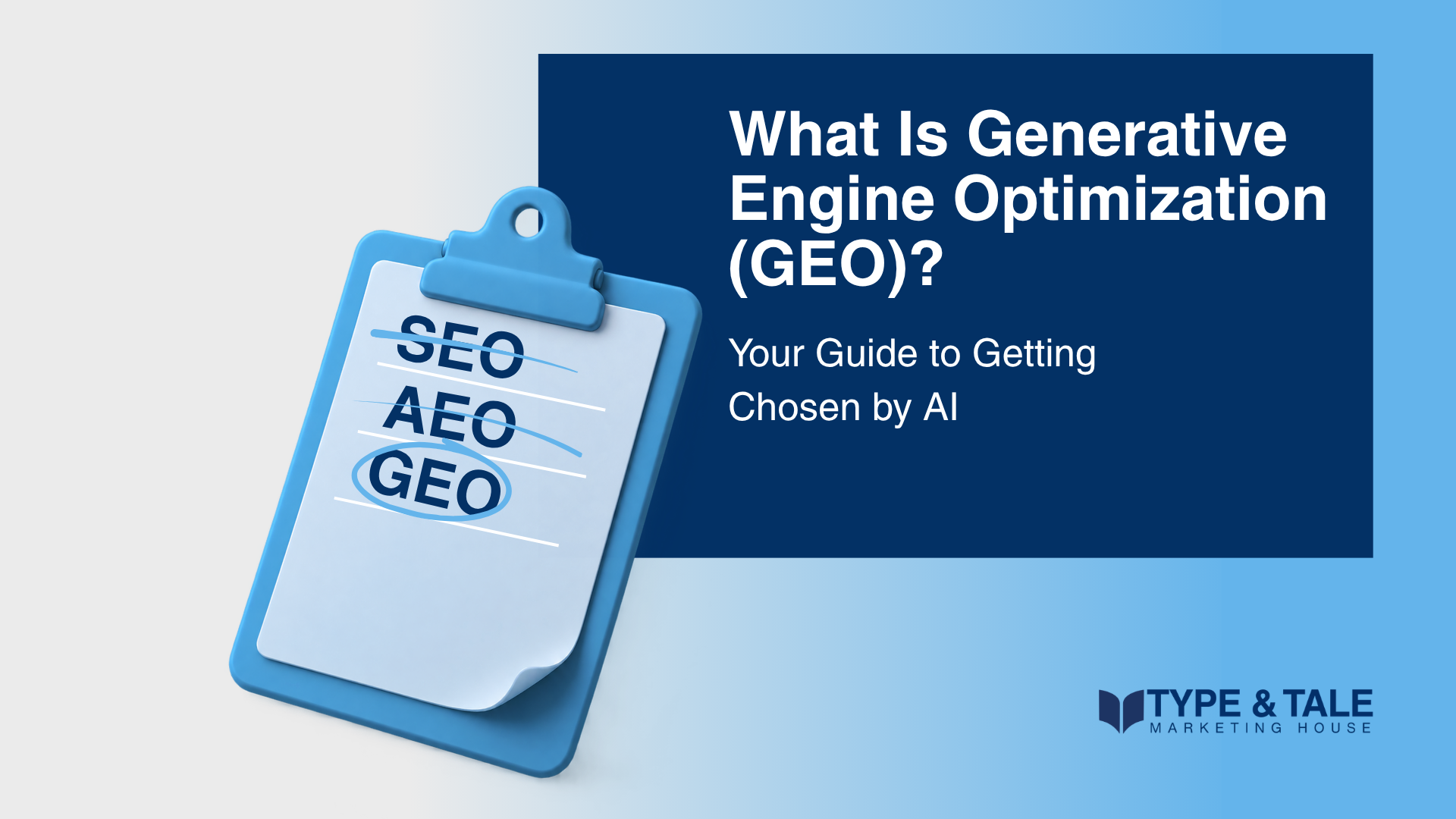
What Is Generative Engine Optimization (GEO)? A Guide to Getting Chosen by AI
For years, search worked in a familiar way:
Someone had a question. They typed it into Google. Google returned a page full of links. Then the person decided what to click.
That process is changing.
Now someone can ask ChatGPT, Gemini, Perplexity, or Google's AI-powered search tools a question and get an answer without starting with a list of websites.
And it interprets the question, gathers information, compares options, and helps narrow the choices.
That changes what it means to be visible online.
In the Search Era, businesses competed to be found. In the Selection Era, businesses compete to be understood well enough to be chosen.
That's where generative engine optimization comes in.
What You'll Learn
- What generative engine optimization means
- How GEO differs from SEO, AEO, and LLMO
- How generative AI systems find and use information
- What makes a business easier for AI to understand and trust
- How to start improving your GEO
- Why the real goal isn't simply getting cited by AI, but getting selected
What Is Generative Engine Optimization?
Generative Engine Optimization (GEO) is the practice of making your business and content easier for generative AI systems to understand, retrieve, trust, cite, and recommend when answering a user's question (arxiv.org).
That definition matters because GEO is often reduced to one goal: Get ChatGPT to mention us.
That's too narrow.
A mention can be useful.
A citation can be useful.
Referral traffic from an AI tool can certainly be useful.
But none of those outcomes alone tells you whether your business is showing up when a potential customer is actually making a decision.
OpenAI says any public website can appear in ChatGPT search. It also tells publishers that allowing OAI-SearchBot to access their content helps make that content discoverable, surfaced, cited, and linked in ChatGPT.
So yes, technical accessibility matters.
But GEO is bigger than crawlability.
The more important question is: When AI is helping someone decide, does your business make sense as part of the answer?
THE CORE CONCEPT
GEO is not just about getting mentioned by AI. It's about becoming clear, credible, and relevant enough to be selected.
Why GEO Matters Now
Traditional search isn't disappearing.
But the path between a person's question and their decision is changing.
ChatGPT search combines conversational answers with current information and links to web sources. Google has also expanded generative search experiences such as AI Overviews and AI Mode, including experiences designed for more complex questions, comparisons, and exploration.
That's a meaningful shift.
A traditional search engine might give someone ten links and let them do most of the comparison.
A generative system can do more of that interpretation first.
It can summarize.
Compare.
Explain.
Recommend.
That means ranking is no longer the only battleground.
The Search Era vs. the Selection Era
SEO has traditionally focused on a question like: Can people find us?
GEO adds another: Can an AI system understand us well enough to use us?
And eventually: Can it understand us well enough to recommend us?
That's the move from visibility to selection.
It also makes messaging clarity more important.
If your website is vague about who you help, what you solve, or what makes you different, you aren't only asking a buyer to interpret your business.
You're asking machines to interpret it too.
This is why Type & Tale treats generic messaging as more than a copy problem. When the meaning of a business is hard to extract, both people and AI systems have more work to do.
How Does Generative Engine Optimization Work?
GEO gets complicated quickly if you treat it as a giant list of tactics.
A simpler way to understand it is through four jobs:
Understand
Make it easy to determine what your business does, who it serves, what problems it solves, and what your content is about.
Retrieve
Make important information accessible, relevant, well-structured, and easy to surface when a user's question calls for it.
Trust
Give AI systems reasons to treat the information as credible through evidence, authorship, citations, expertise, consistency, and outside corroboration.
Select
Become relevant and credible enough to make the final answer, comparison, citation, or recommendation.
These aren't four isolated tactics.
They build on each other.
A page can't be selected if it isn't retrieved.
It won't be retrieved reliably if its subject is unclear.
And being retrieved doesn't mean it will be trusted enough to influence an answer.
That's why good GEO is less about one technical trick and more about reducing ambiguity throughout your digital presence.
Good GEO makes information easier to understand, easier to retrieve, easier to trust, and easier to select.
GEO vs. SEO vs. AEO vs. LLMO
One challenge with AI search is the explosion of acronyms.
SEO vs. GEO vs. AEO. And of course, LLM.
| Discipline | Primary Goal |
|---|---|
| SEO | Be found through search |
| AEO | Make information easy to use as a direct answer |
| LLMO | Improve visibility within large language model environments |
| GEO | Make information easier for generative systems to understand, use, cite, and select |
The terminology is still developing, so pretending there are perfect industry-wide boundaries would create more clarity problems than it solves.
But there is a useful way to think about them.
Does GEO Replace SEO?
No.
In fact, Google's current guidance is unusually clear on this point: SEO best practices remain relevant for its generative AI search features. Google says there are no special technical requirements, GEO-specific files, or unique schema markup required to appear in AI Overviews or AI Mode.
You still need crawlable pages.
Useful content.
Clear site architecture.
Technical health.
Relevant information.
Authority.
GEO extends the job.
SEO asks whether a search engine can find and rank the page.
GEO asks whether a generative system can interpret and use what it finds.
For a deeper breakdown, Type & Tale's SEO vs. GEO vs. AEO guide explores how those disciplines work together.
What Helps a Business Get Chosen by AI?
There is no switch you can flip to make ChatGPT recommend you.
OpenAI says ChatGPT search ranking relies on multiple factors intended to surface relevant and reliable information, and placement is not guaranteed.
So the practical job is to improve the signals you can control.
1. Clear Positioning and Messaging
Start here.
Not schema.
Not prompt hacks.
Not another AI visibility tool.
Can someone quickly tell:
Who do you help?
What problem do you solve?
What do you actually offer?
What category are you in?
Why are you different?
If your own website gives five different answers, AI has to resolve that ambiguity too.
Clear language does more than improve conversion.
It creates cleaner information.
2. Topical Depth
One article doesn't create meaningful authority around a subject.
Build connected coverage.
A strong GEO content system might include a central pillar page supported by focused articles answering narrower questions.
3. Direct, Structured Answers
Don't bury the answer beneath 500 words of setup.
If the heading asks, “What is generative engine optimization?” answer it.
Then explain.
Clear headings, direct definitions, useful comparisons, and self-contained sections make information easier for humans to scan and machines to interpret.
Google's guidance reinforces an important point here: there is no special GEO markup required for its AI features. It recommends useful, reliable, people-first content, crawlability, internal linking, textual accessibility, and structured data that accurately matches the visible page.
4. Trust Signals
Claims become more useful when they have support.
That can include:
named authors
expert experience
first-party examples
original data
credible citations
clear dates
consistency across pages
reputable third-party mentions
These signals don't guarantee selection.
But they give both buyers and AI systems more context for evaluating whether something deserves trust.
5. Presence Beyond Your Website
Your website is important.
It is not the entire information environment.
Generative systems may encounter information about a business through publishers, directories, reviews, databases, news coverage, and other third-party sources.
That means brand consistency matters.
If your website describes you one way and the rest of the web describes you another, the picture becomes harder to interpret.
The goal isn't to be everywhere.
It's to create enough consistent evidence that the right picture emerges.
How to Start Improving Your GEO
You do not need to rebuild your entire marketing strategy around AI tomorrow.
Start with five questions.
1. Is your business clear?
Can a stranger explain what you do, who you serve, and why you matter after looking at your website for a few moments?
2. What topics should you be known for?
Choose subjects connected to your actual expertise and the problems buyers need solved.
3. Are your best answers explicit?
Turn buried knowledge into clear definitions, explanations, comparisons, examples, and answers.
4. Have you earned trust?
Support claims. Show experience. Cite credible sources. Keep important information consistent.
5. Are you testing selection or just mentions?
Don't only ask ChatGPT, “Do you know Type & Tale?”
Test prompts a buyer might actually use:
“Who helps established businesses clarify their messaging?”
“What should I look for in a messaging consultant?”
“What companies specialize in GEO strategy?”
Those questions reveal something more valuable than brand awareness.
They reveal whether you're entering the consideration set.
GEO Is Not About Gaming AI
The wrong question is: How do we trick ChatGPT into mentioning us?
The better question is: How do we become the clearest, most credible, most relevant source for the questions our buyers are asking?
The second question is harder.
It also produces a better business.
Because if your offer is unclear, your website is generic, your expertise is thin, and nobody else validates your claims, an AI optimization trick won't solve the underlying problem.
Most businesses don't need another AI tactic first.
They need to become easier to understand.
Frequently Asked Questions About Generative Engine Optimization
-
GEO stands for Generative Engine Optimization. It refers to improving how easily generative AI systems can understand, retrieve, cite, and recommend information about your business or expertise.
-
No. Strong SEO fundamentals remain important. Google's current guidance says SEO best practices continue to matter for generative AI features such as AI Overviews and AI Mode.
-
You can improve its eligibility and usefulness, but you cannot guarantee placement. OpenAI recommends allowing OAI-SearchBot if you want content eligible to be discovered and surfaced through ChatGPT search.
-
Useful measurements include AI citations, brand mentions, referral traffic, visibility across relevant prompts, and how often your company appears in recommendation or consideration-stage questions. Google also began testing dedicated Search Generative AI performance reporting in Search Console in June 2026.
From Visibility to Selection
SEO still matters.
Search still matters.
But there's a new layer between the question and the choice.
AI systems are increasingly helping people interpret information, compare options, and narrow decisions.
That means businesses need to ask more than: Can people find us?
They also need to ask: Can people—and machines—understand why we belong in the answer?
Being visible matters.
Being selected matters more.
Can AI understand why it should recommend your business?
GEO isn't about chasing AI tricks. It's about making your business clearer, more credible, and easier to select. Type & Tale helps brands strengthen the signals that shape how AI understands and recommends them.
Explore Type & Tale's GEO services.

Author: Noah Swanson
Noah Swanson is the founder and Chief Content Officer of Type and Tale.