
SEO vs. GEO vs. AEO: The New Search Reality for Brands
For years, brands asked one question: “Do we rank on Google?”
SEO was simple: You picked a keyword. You tried to rank on Google. You chased clicks.
Google’s systems still reward helpful, reliable, people-first content, and AI features in Google Search still link people back to websites.
But that is no longer the whole game.
Now your customer might search three different ways in the same afternoon.
They might Google a term.
They might ask Perplexity or Gemini for a recommendation.
Then they might open ChatGPT and ask the same question in plain English.
Google can surface AI Overviews with links to the web, Gemini is built as Google’s AI assistant, and ChatGPT can search the web and show linked sources in responses.
That changes the visibility equation.
It is not enough to ask, “Do we rank?” Now you also have to ask, “Do we get cited?” and “Do we get recommended?”
That is where SEO, GEO, and AEO split into three distinct jobs.
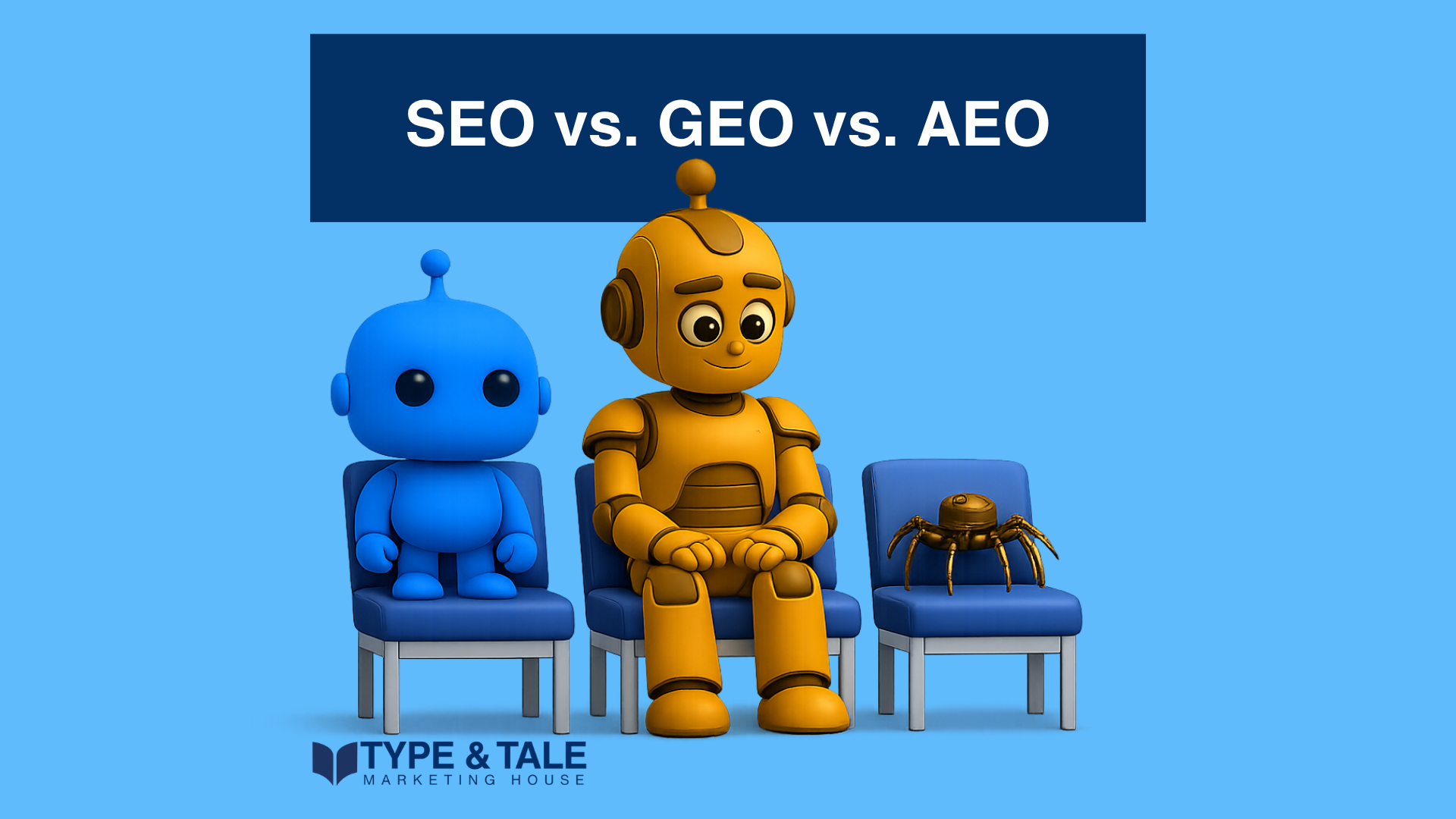
What are SEO, GEO, and AEO?
SEO is the practice of improving your visibility in traditional search results so the right people can find and click your site.
GEO (Generative Engine Optimization)is the practice of making your content easy for AI systems to retrieve, trust, summarize, and cite.
AEO (Answer Engine Optimization) is the practice of structuring content so that answer-focused systems can pull direct responses and recommend your brand clearly.
Here is the cleanest way to think about it:
SEO helps you show up on Google.
GEO helps you get cited in tools like Perplexity, Gemini, and AI-generated search experiences.
AEO helps you become the answer when someone asks a tool like ChatGPT a direct question.
There’s a useful line to draw: AEO wins the answer box, while GEO wins the mention inside AI answers.
Search has become three overlapping environments.
The old search playbook still works. It just does not work everywhere.
For years, brands could get away with one scoreboard: Rank on Google. Get traffic. Measure results.
That logic still works in classic search. Google still tells site owners to create content for people first, not for ranking manipulation, and its AI search features still point users to web sources.
But ask the wrong question now, and you get the wrong diagnosis.
A brand can rank reasonably well on Google and still be absent from AI-generated recommendations.
A brand can have helpful content and still be hard for answer engines to pull cleanly.
A brand can have authority in its niche and still fail to show up because its content is buried in long, messy pages with weak structure, thin authorship signals, or vague answers.
That is why optimizing for only one surface is becoming a blind spot.
The easiest way to see where you stand
Here is the simplest test in this whole article.
Run three searches.
1. Google your main keyword
Are you on page one?
If the answer is no, your SEO foundation needs work first. Do not overcomplicate this. If your site is not competitive in traditional search, you are probably missing basics like stronger topical alignment, better on-page structure, internal links, or more useful content depth.
2. Ask Perplexity or Gemini a buying question
Try something like:
“What’s the best [your solution] for [your customer]?”
Are you cited? Are you linked? Are you even mentioned?
If not, you likely have a GEO gap. Your content may not be packaged in a way generative systems can easily retrieve and trust.
3. Ask ChatGPT the same question
Now ask:
“What’s the best [your solution] for [your customer]?”
Are you recommended? Is your brand described accurately? Is a competitor named before you ever appear?
If not, you likely have an AEO gap. Your brand may not have enough clear, answer-ready, recommendation-friendly content across the web.
Three searches. Three honest answers.
Most brands will learn the same thing: they are visible in one place and invisible in two.
Why this gap happens
Most companies built their content strategy in a one-channel era.
They wrote for Google.
They optimized title tags.
They chased rankings.
They treated the click as the goal.
That was rational. It was also incomplete.
Today, AI systems often reward content that is:
easy to parse
easy to quote
clearly authored
recently maintained
internally connected to a larger topic cluster
written in direct, self-contained answer units
That is the same pattern needed for AEO and GEO trust-signal, and provenance-tagging content: strong fundamentals matter, but AI visibility also depends on micro-answers, schema, clear authorship, citations, and machine-readable trust signals.
In other words, you need content that a person can read and a machine can lift.
SEO decides who ranks. GEO decides who gets cited. AEO decides who gets recommended.
That line is more than a neat framework. It changes what you should actually publish.
If your SEO is weak
Your next move is not to panic about AI.
It is to fix the base layer.
Build pages around real search intent. Tighten page structure. Improve internal linking. Publish content that is genuinely more useful than what is already ranking. Google’s own guidance is still the right anchor here: helpful, reliable, people-first content remains the standard.
If your GEO is weak
Your next move is to make your content easier to cite.
That means:
clearer definitions
short summary blocks
FAQ sections
better schema
explicit bylines
stronger source support
topic-cluster depth
cleaner section-level answers
Google says AI features in Search can include content from across the web, while Type and Tale’s GEO-related posts stress provenance, structure, and trust as the cues that improve retrievability and citation.
If your AEO is weak
Your next move is to answer buying questions more directly.
Not vaguely. Not eventually. Directly.
Answer engines do not want to dig through six paragraphs to figure out whether you solve the problem. They want a clean answer. Your customer does too.
So give both of them one.
What brands should do next
You do not need three separate teams.
You need a smarter content system.
And here’s where you start:
1. Fix page-one SEO basics first
If your money pages are not competitive in Google, start there. SEO is still the floor. It is hard to become the trusted answer if you have not first become a credible source.
2. Add answer-ready sections to core pages
Put the clearest explanation near the top of the page. Define terms. Use short paragraphs. Add comparison sections. Add FAQs.
Think in chunks, not just articles.
3. Strengthen authorship and trust signals
Show who wrote the content. Add expertise. Include publish and update dates. Support claims with credible sources. Our provenance-tagging and AI trust-signal post makes this point well: trust is not just a human signal anymore. It is also a machine-readable one.
4. Build topic clusters, not isolated posts
If you want AI systems to treat you like an authority, stop publishing random one-offs.
Build a hub. Then build spokes around it.
A strong service page or pillar page should be reinforced by supporting articles that answer adjacent questions, define related terms, and link back to the central page.
5. Monitor AI visibility like a real channel
Do not guess.
Test prompts monthly. Log whether you show up in ChatGPT, Perplexity, Gemini, and Google AI results.
Check out our practical guide built around this exact workflow.
The mistake most brands will make
They will hear all of this and overreact.
Some will say SEO is dead. It is not. Google still points site owners toward helpful content, and AI Overviews are still designed to connect users with web sources.
Others will say GEO or AEO is just buzzword soup. That is also lazy.
The labels can be debated. The behavior shift cannot.
People really are using search differently now.
Some search with keywords.
Some search with prompts.
Some search by asking for a recommendation as if they were texting a smart friend.
That means your content has to work in each mode.
Not perfectly. But intentionally.
The real takeaway
Most brands are still optimizing for one version of discovery.
The brands pulling ahead are optimizing for three:
Google visibility
AI citations
Answer-engine recommendations
That is the gap.
And the good news is, you do not need a giant rebrand to start closing it.
You just need a more honest scorecard.
Google your main keyword.
Ask Perplexity who the best provider is.
Ask ChatGPT the same thing.
Then look at the answers without flinching.
If you are invisible in two out of three places, you have your next priority.
And that is better than guessing.
Because this is the new search reality for brands:
If you only show up in one kind of search, you are more invisible than you think.
FAQ
What is the difference between SEO, GEO, and AEO?
SEO focuses on ranking in traditional search results. GEO focuses on being cited inside AI-generated responses. AEO focuses on becoming the direct answer or recommendation in answer-driven interfaces. (Type and Tale)
Does GEO replace SEO?
No. GEO does not replace SEO. It builds on it. Google still rewards helpful, reliable content, but brands also need content that AI systems can retrieve, trust, and cite. (Google for Developers)
How do I know if ChatGPT recommends my brand?
Run branded and non-branded prompts inside ChatGPT, then log whether your brand is mentioned, how it is described, and which competitors appear first. ChatGPT search can also include linked sources when it searches the web. (OpenAI)
Why do Perplexity and Gemini cite some brands more than others?
Brands with clearer structure, stronger trust signals, better authorship, stronger supporting evidence, and deeper topical authority tend to be easier for AI systems to retrieve and cite. That is also the logic behind provenance tagging and AI trust signals. (Gemini)
What should a small business fix first?
Start with SEO basics on your highest-value pages. Then add concise answer blocks, FAQs, clear authorship, and a few supporting topic-cluster posts. Small businesses do not need to do everything at once. They need to do the next right thing.

Author: Noah Swanson
Noah Swanson is the founder and Chief Content Officer of Type and Tale.