
Why Confused Customers Don’t Buy—and What Clear Messaging Changes
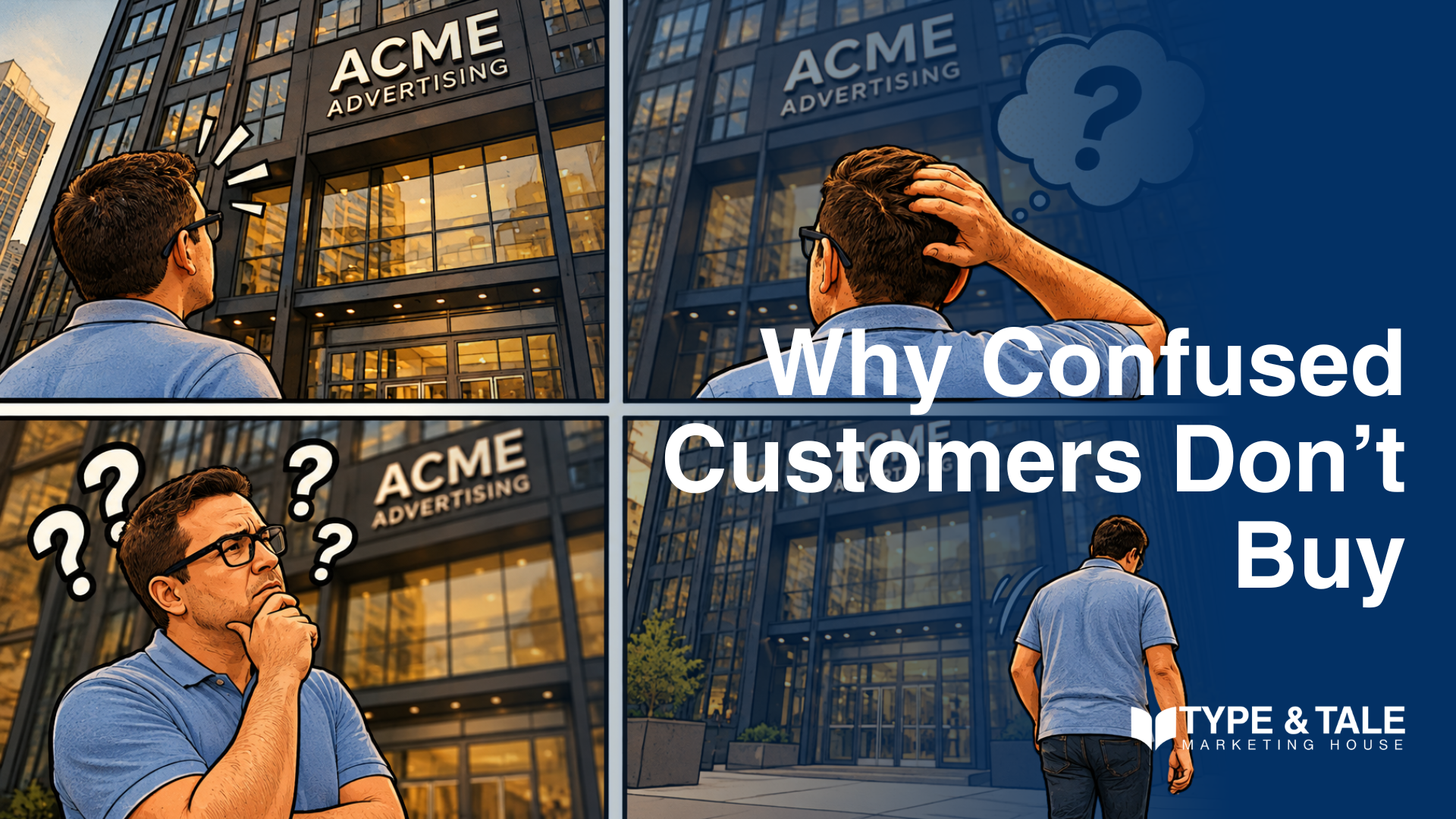
A potential customer lands on your website.
They’re interested enough to stick around.
They read the headline. Scroll a little. Read about your services. Maybe even click to another page.
But a few minutes later, they leave.
It’s easy to assume they weren’t the right customer.
But there’s another possibility: They never fully understood why they should choose you.
Confused customers are less likely to buy because unclear messaging increases cognitive effort and uncertainty. Clear messaging makes it easier for customers to understand an offer, evaluate whether it is relevant, and confidently decide what to do next.
That is why messaging clarity matters.
Not because clear copy sounds nicer. Because clarity makes buying easier.
What You’ll Learn
- Why confusion creates friction in buying decisions
- How unclear messaging increases uncertainty
- Why adding more information can make the problem worse
- What customers actually need to understand before they buy
- How to test whether your marketing message is clear enough
Why Confusion Makes Buying Harder
Your brain is constantly looking for shortcuts.
Imagine consciously analyzing every sound, sight, choice, word, and decision you encounter all day long. You wouldn’t make it through breakfast.
So our brains like things they can process easily.
Psychologists call this processing fluency: the subjective feeling of how easy or difficult information is to process. Research by Adam Alter and Daniel Oppenheimer found that processing fluency can affect judgments across a wide range of situations.
In plain English: Easy-to-understand information feels different from hard-to-understand information.
That matters when someone encounters your marketing.
If a customer immediately understands:
who you help,
what problem you solve,
what you offer,
why it matters, and
what they should do next,
they can spend their mental energy deciding whether they want what you're selling.
Confusion creates uncertainty
There is another problem.
Confusion doesn't stay neatly contained inside your copy.
It starts creating questions. “Is this really for a company like mine?” and “What exactly am I paying for?”
The more unanswered questions a buyer carries, the harder it becomes to move confidently.
That does not mean every uncertainty must disappear before someone buys. Buying anything meaningful involves some risk.
But your messaging should not create unnecessary uncertainty.
Customers Rarely Work Hard to Understand Your Business
You know your company too well.
That can be a problem.
You've spent years thinking about your service, your process, your market, your differentiators, and your customers.
Your buyer hasn't. What feels obvious to you may be completely invisible to them.
So businesses make assumptions: “They'll understand what we mean,” or “People in our industry know what that term means.”
Maybe.
Your customer is searching for signals.
Is this relevant to me?
Do these people understand my problem?
Can they help?
That's why generic messaging is so expensive.
As we've written before about why your messaging fails, unclear messaging makes every tactic around it work harder.
Every time your customer has to interpret your message, you transfer work from your business to the buyer.
More Information Does Not Always Create More Clarity
When customers aren't converting, businesses often assume they didn’t do enough: “We must not have explained enough.”
But information and clarity are not the same thing.
You can explain something in 2,000 words and leave someone completely lost.
You can also explain it in two sentences and make it click.
The difference is not word count.
The difference is whether the information helps the buyer organize the decision.
Information answers questions. Clarity tells buyers what matters.
Imagine a company offers six service packages.
Nothing is inherently wrong with six options.
The problem starts when customers cannot tell:
which option is designed for them,
how the options differ,
what problem each solves, or
what they sacrifice by choosing one over another.
You'll often hear this reduced to:
“Too many choices kill sales.”
The research is more complicated.
A large meta-analysis of choice-overload studies found no universal effect where simply increasing the number of choices consistently made outcomes worse. Later research found that factors including choice complexity, decision difficulty, and uncertainty about preferences help determine when a large assortment becomes overwhelming.
That's an important distinction.
More options aren't automatically confusing. Poorly organized options are.
A 40-item restaurant menu can be understandable when everything is clearly categorized.
Three consulting packages can be frustrating when all three sound almost identical.
The goal is not always to say less.
The goal is to make the decision easier to understand.
What Customers Need to Understand Before They Buy
Your customer does not need a graduate-level education in your company.
They need enough understanding to make the next decision.
Start with five questions.
1. Is this for me?
Your buyer should recognize themselves.
Compare:
“We provide customized business solutions for growing organizations.”
with:
“We help established service businesses clarify their marketing before they spend more money trying to scale it.”
The first could mean almost anything.
The second gives someone a chance to say:
“That's me.”
Specificity excludes some people.
That's the point.
Trying to sound relevant to everyone often makes you recognizable to no one.
2. Do you understand my problem?
Businesses naturally want to talk about what they sell.
Buyers are thinking about what they need solved.
Those are not the same starting points.
A messaging company sells messaging strategy.
But the customer may be thinking:
“Our website doesn't explain what makes us different.”
A financial advisor sells financial planning.
The buyer may be thinking:
“I make good money, but I still don't know whether I'm on track.”
A contractor sells remodeling.
The homeowner thinks:
“This kitchen doesn't work for our family anymore.”
Problem before product.
The faster buyers recognize their struggle in your message, the less explaining you have to do later.
This is one reason the Effective Stories System™ begins with the customer and their struggle before making the brand or solution the center of the story.
3. What are you actually offering?
Read your website and ask yourself:
Could a reasonably intelligent person outside my industry explain what we sell?
If not, remove the jargon.
You don't “provide integrated, end-to-end growth solutions.”
What do you actually do?
You don't “empower organizations through transformational strategic initiatives.”
How?
Clarity requires you to make choices.
Some language is technically accurate but practically meaningless.
Your customer needs the practical meaning.
4. Why should I believe this will help?
Clarity alone does not create trust.
It makes trust easier to evaluate.
Give customers evidence.
That might include:
examples,
testimonials,
results,
credentials,
a defined process,
experience,
clear explanations, or
a point of view that demonstrates you understand the problem.
Don't just tell buyers you're credible.
Give them something they can use to reach that conclusion themselves.
5. What should I do next?
A customer understands what you do.
Great.
Now what?
Call?
Book?
Buy?
Request a proposal?
Start an assessment?
Read something first?
Don't make the next step a scavenger hunt.
A clear call to action is part of the message.
Because understanding without direction still leaves the buyer standing still.
Clear Messaging Reduces Risk
Every purchase includes risk.
Sometimes it's financial.
Sometimes it's professional.
Sometimes it's emotional.
Hiring the wrong consultant can waste $20,000.
Choosing the wrong software can disrupt an entire team.
Picking the wrong contractor can turn your kitchen into a six-month nightmare.
Even smaller purchases carry some risk:
“Will I regret spending money on this?”
Your messaging cannot remove all of that.
Nor should it try.
But it can remove risk caused simply by not understanding the offer.
Consider the difference.
A confusing business leaves you wondering:
“I don't really know what I'm getting.”
A clear business allows you to think:
“I understand what I'm getting. Now I can decide whether it's right for me.”
Those sound similar.
Psychologically, they are very different decisions.
Clear messaging does not force customers into a decision. It gives them enough understanding to make the decision with greater confidence.
That's what clarity is supposed to do.
How to Tell If Your Messaging Is Confusing
Confusing messaging rarely announces itself.
Nobody gets an alert saying:
“Warning: your value proposition makes no sense.”
You see the symptoms instead.
Prospects keep asking what you actually do
One question isn't a problem.
But when the same basic question keeps appearing, pay attention.
Your customers may be telling you where your message is failing.
Your sales team has to translate your marketing
If every sales call starts with:
“So, what we actually mean by that is…”
your website isn't finished doing its job.
Sales should deepen understanding.
It shouldn't have to create understanding from scratch.
Different people describe the company differently
Ask five employees:
“What do we do, who do we do it for, and why do customers choose us?”
If you get five materially different answers, customers are probably hearing five different stories too.
Your homepage requires too much patience
Look at your homepage without scrolling.
Can someone understand enough to want the next piece of information?
Not everything.
Enough.
If the first useful explanation sits 700 words down the page, you're asking for attention you haven't earned yet.
Customers compare you almost entirely on price
Price sensitivity has many causes, so don't assume messaging is always the culprit.
But unclear differentiation can make price one of the only visible differences left.
If every competitor sounds the same, customers need some way to compare.
Price is easy.
Your CTA requires more confidence than your message creates
“Schedule a consultation” might feel simple to you.
For a buyer who still doesn't understand the service, it can feel like a commitment.
The strength of the ask should match the confidence created by everything before it.
If several of these symptoms sound familiar, it may be time to improve your messaging before adding another marketing tactic.
The Five-Question Messaging Clarity Test
Pull up your homepage.
Don't rewrite anything yet.
Just answer these five questions:
Can someone tell who this is for?
Can they identify the problem you solve?
Can they explain what you actually do?
Can they see a reason to trust you?
Can they identify what to do next?
Better yet, ask someone who does not work for your company.
Don't explain the page first.
Don't provide context.
Don't defend the language.
Show it to them.
Then listen.
If customers have to infer the answers to several of these questions, your message is doing less work than it should.
When customers have to figure out what you mean, you have made understanding their job.
Clearer Messaging Makes Every Other Marketing Tactic Work Harder
Messaging is not a substitute for marketing.
You can have a perfectly clear message nobody sees.
You still need distribution.
SEO matters.
Advertising matters.
Content matters.
Email matters.
Sales matters.
Brand matters.
But every one of those tactics carries a message.
And that creates an important order of operations.
If the message is weak, increasing distribution doesn't fix it.
More traffic cannot fix a message people don't understand. It only gives more people the opportunity to misunderstand it.
The same principle applies to content.
Publishing more won't necessarily make your business easier to choose if every piece of content adds another disconnected explanation of what you do. The question is increasingly not just whether people can find you, but why your content gets chosen once you're one of the options.
Clarity gives the rest of your marketing direction.
Your ads get easier to write.
Your sales conversations get easier to start.
Your website gets easier to structure.
Your content gets easier to focus.
Your customer gets a simpler decision.
Not because you said less.
Because you made what you said easier to understand.
Clarity Does Not Mean Saying Less. It Means Making Less Work for the Buyer.
“Keep it simple” is incomplete advice.
Some businesses sell complex things.
Some purchases require detail.
Some buyers need substantial information before they can make a responsible decision.
That's fine.
Clear is not the same as short.
Simple is not the same as simplistic.
The real question is:
Can the right customer quickly understand enough to make the next decision?
That's the standard.
Your customer should spend their mental energy deciding whether they want what you offer.
Not figuring out what you're offering.
Before you spend more money getting people to your message, make sure the message itself is doing its job.
In Short
Confusion makes buying harder because it adds effort and uncertainty to the decision. Clear messaging reduces that friction by helping customers understand who an offer is for, what problem it solves, what the business actually provides, why the customer should trust it, and what to do next.
Frequently Asked Questions
Why don't confused customers buy?
Confused customers are less likely to buy because uncertainty makes a decision harder. If buyers do not understand what an offer is, whether it fits their problem, why it is different, or what happens next, they have more questions to resolve before acting. Clear messaging removes unnecessary decision friction.
What is messaging clarity?
Messaging clarity is the degree to which a customer can quickly understand who an offer is for, what problem it solves, what is being offered, why it matters, and what action to take next. Clear messaging does not mean removing all detail. It means organizing information so customers do not have to interpret the basic value themselves.
How does unclear messaging affect sales?
Unclear messaging can create hesitation, force salespeople to spend time explaining basic positioning, make offers harder to compare, and leave price as one of the few obvious points of differentiation. It may also cause otherwise qualified buyers to leave before they understand why a business is relevant to them.
How can I tell if my marketing message is confusing?
Look for repeated questions from prospects, inconsistent explanations from employees, vague homepage copy, salespeople constantly translating the marketing, or customers who struggle to explain what you do. You can also use the five-question clarity test: buyer, problem, offer, trust, and next step.
Does simpler messaging increase conversions?
Not automatically. Simple messaging can still be vague. Detailed messaging can still be clear. The better goal is to reduce unnecessary cognitive effort so customers can understand and evaluate the offer. Clarity matters more than merely reducing the number of words.
How do you make brand messaging clearer?
Start by identifying exactly who you're speaking to and the problem they want solved. Explain the offer in concrete language, prioritize the information customers need to make a decision, establish reasons to trust you, and make the next step obvious. Remove language that sounds impressive but requires the customer to interpret what it actually means.

Author: Noah Swanson
Noah Swanson is the founder and Chief Content Officer of Type and Tale.