
To create a customer avatar, gather evidence from real buyers, identify their problem and buying trigger, document how they decide, and turn those patterns into a one-page profile your team can use.
A customer avatar is a humanized representation of the specific person your marketing is trying to reach. Its value comes from the decisions it improves.
What You'll Learn
- How to research buyers using real evidence
- Seven steps to build and use a customer avatar
- Interview questions that uncover the buying moment
- A completed example and a copy-and-paste worksheet
For the broader framework, see our complete customer avatar guide. Comparing terminology? Read customer avatar vs buyer persona.
Step 1: Define the Decision Your Avatar Should Improve
Choose one offer and one marketing decision. An avatar for rewriting a homepage needs different detail from one used to map a buying committee.
Write: “This profile will help us explain [offer] to [buyer] so they can [next step].” If a detail will not change the message, offer, channel, or buying experience, leave it out.
Step 2: Gather Evidence From Real Buyers
Review sales conversations, customer reviews, inquiry forms, and CRM records. Interview recent buyers and, where possible, people who considered your business but chose another option.
Keep an evidence log: observation, source, date, and what remains uncertain. Separate an actual customer quote from your interpretation. Analytics can show behavior; a conversation can help explain it.
HubSpot offers a useful buyer persona research guide. The application below focuses on turning customer insight into Type & Tale messaging decisions.
Step 3: Identify the Buyer, Problem, and Moment
Document who buys, what they are trying to solve, and what happened that made solving it a priority. This is Type & Tale’s Buyer → Problem → Moment framework.
Buyer: Who experiences the problem, evaluates options, and approves the purchase?
Problem: What is difficult now, and what outcome would make a difference?
Moment: What changed immediately before the search for help began?
Demographics belong in the profile when they affect the decision. Age or income alone will not tell you why someone is ready to buy.
Step 4: Connect Pain Points to Desired Outcomes
Use the buyer’s language to describe the frustration and a specific, credible outcome. Avoid promising that better messaging makes sales effortless.
Example: “People ask what we do even after visiting our website” → “Visitors understand our service and know whether to book a conversation.”
Pain Points & Desired Outcomes
Every strong customer avatar has a transformation story. Use this table to connect your audience’s frustrations to their desired results.
| Pain Point | Desired Outcome |
|---|---|
| “I’m overwhelmed by marketing my business.” | “I feel confident and in control with a clear plan.” |
| “Our website doesn’t convert.” | “Visitors understand our service and know how to inquire.” |
Tip: Write at least 3–5 of these transformations to clarify your brand story and positioning.
Step 5: Map the Buying Decision
Document the alternatives buyers consider, their objections, who else influences the decision, and the proof they need. Ask about a recent purchase rather than what someone imagines they might do.

Five Customer Interview Questions
What was happening when you first started looking for help?
What had you already tried?
Which alternatives did you compare, including doing nothing?
What nearly stopped you from choosing us?
What finally gave you enough confidence to decide?
Follow up with “Can you walk me through that?” Record exact language with permission and remove identifying details before sharing examples publicly.
Step 6: Write a Human Profile Without Inventing Evidence
Summarize the patterns in a short narrative. A memorable label is optional. A stock photo and invented hobbies do not make the research stronger.
Keep unknowns visible. “We suspect installation disruption is a concern; validate in interviews” is more useful than presenting a guess as a customer fact.
Separate Evidence From Assumptions
| Record | Illustrative entry |
|---|---|
| Observation | A buyer asked how long installation would disrupt the house. |
| Evidence source | An anonymized interview note, with date. |
| Interpretation | Disruption may matter alongside price. |
| Next question | Does this concern recur in other interviews? |
One conversation is a clue. Look for recurring patterns before treating it as a conclusion.
Keep the evidence log beside your profile so your team can see what is known and what still needs validation.
Step 7: Apply, Share, and Update the Avatar
Use the profile to rewrite one headline, answer one sales objection, and choose one useful content topic. Share it with everyone who writes, sells, or designs the buying experience.
Check whether the new message attracts appropriate inquiries and whether sales conversations support the profile. Update it when evidence changes, especially after a new offer, a different customer segment, or recurring objections.
Completed Customer Avatar Example
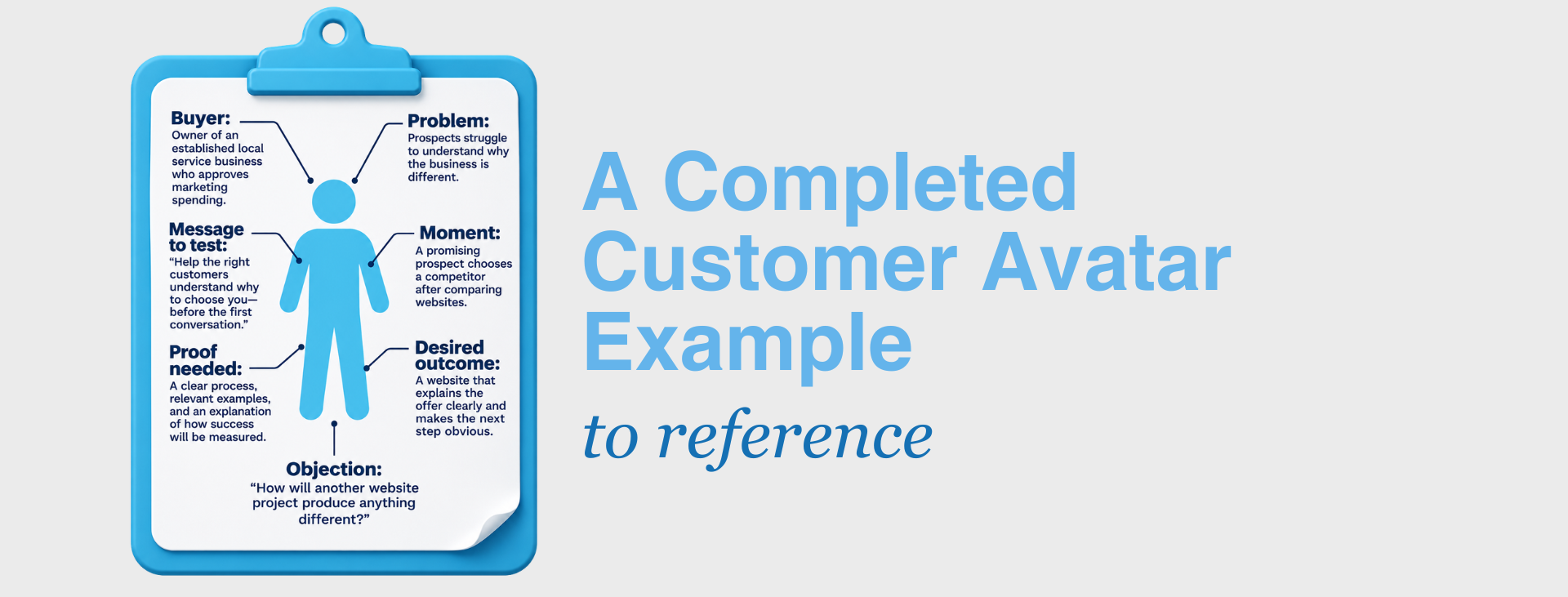
Illustrative example, not a client case study.
Buyer: Owner of an established local service business who approves marketing spending.
Problem: Prospects struggle to understand why the business is different.
Moment: A promising prospect chooses a competitor after comparing websites.
Desired outcome: A website that explains the offer clearly and makes the next step obvious.
Objection: “How will another website project produce anything different?”
Proof needed: A clear process, relevant examples, and an explanation of how success will be measured.
Message to test: “Help the right customers understand why to choose you—before the first conversation.”
Copy-and-Paste Customer Avatar Worksheet
Copy these prompts into your working document. Add an evidence source beside each answer.
Offer and decision this profile supports:
Buyer and role in the purchase:
Problem in the buyer’s own words:
Event that triggered the search:
Desired outcome:
Alternatives and objections:
Proof and decision criteria:
Message, channel, and next step to test:
Evidence sources, unknowns, and review date:
Can someone use this profile to make a better marketing decision today?
Common Customer Avatar Mistakes (and How to Fix Them)
Even experienced marketers make these mistakes when defining their ideal customer. Use this table as a quick reference for what to avoid.
| Mistake | Why It Hurts | Fix |
|---|---|---|
| Creating avatars from guesswork | Attracts the wrong audience and wastes resources | Base avatars on research, interviews, and real data |
| Adding too much detail | Creates confusion and dilutes focus | Keep only traits that directly influence buying behavior |
| Treating it as a one-time exercise | Becomes outdated as your market evolves | Revisit your avatar annually or after a major shift |
| Forgetting the story element | Makes your brand sound robotic and impersonal | Center your avatar on emotion and transformation |
Pro tip: Revisit this list every quarter to keep your marketing aligned with your audience’s evolving story.
Customer Avatar FAQ
How do I create a customer avatar?
Define its purpose, collect customer evidence, connect Buyer → Problem → Moment, identify outcomes, map the purchase decision, summarize the profile, and apply it to your marketing.
How many customer avatars should I create?
Start with one priority buyer. Create another when evidence shows a meaningful difference in the problem, buying process, offer, or message.
Can I create an avatar without existing customers?
Interview prospective buyers and research relevant reviews and alternatives. Label the profile as a hypothesis, then refine it as real inquiries and purchases provide evidence.
Can AI create my customer avatar?
AI can organize anonymized research and suggest questions. It cannot replace customer evidence. Treat generated motivations, quotes, and buying triggers as hypotheses until validated.
How often should I update my avatar?
Revisit it when customer evidence changes, especially after a new offer, a shift in buyer type, or repeated sales objections.
Turn Customer Understanding Into Clearer Messaging
If your team can describe its customer but still cannot explain why that customer should choose you, the next task is applying the insight.
Talk with Type & Tale about your messaging. We will start with who you serve, the problem you solve, and the moment your offer becomes relevant.
Turn customer insight into a clearer message.
If your team can describe its customer but still struggles to explain why that customer should choose you, let’s put the profile to work. We’ll start with the buyer, the problem, and the moment your offer becomes relevant.
LET’S CLARIFY YOUR MESSAGE
Author: Noah Swanson
Noah Swanson is the founder and Chief Content Officer of Type and Tale.